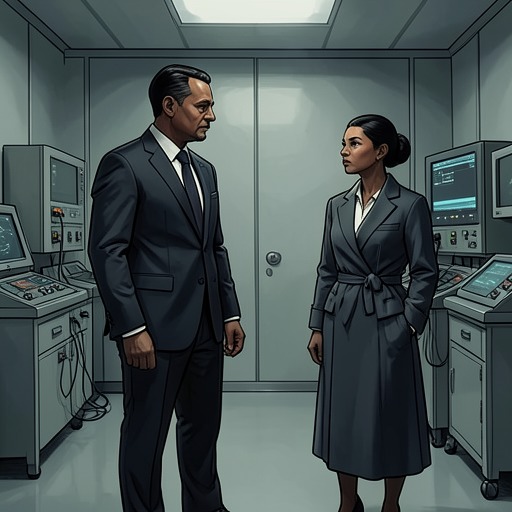
Clandestine Computer Services
The Robot Who Looked Like MeClandestine Computer Services is a clandestine operation that repurposes access to the Political Factors Synthesizer and Simulator (PFSS) for private use. Under the cover of a small used-software business, it arranges for Peter Honorious to experience computer-generated projections of life with prospective wives. Its defining resource is not ownership of the powerful state forecasting system, but a covert route into its output: a captive terminal concealed away from the PFSS itself.
Cover and Organization
Clandestine Computer Services is headed by Euler, whom an associate recommends to Honorious when he seeks a practical way to reduce uncertainty about marriage. The organization has temporarily established itself in a suite of dusty offices in the derelict Lincoln Center area, where it presents itself as Used Softwear Jobbers, Inc. That storefront gives the operation an ordinary commercial guise, while its actual work depends on secret access to a strategic computer system.
Euler’s office reinforces the contrast between respectable appearance and illicit method. He is described as friendly and disarming, and has tried to furnish the room like an English drawing room, though it resembles a corner of a furniture warehouse. His personable manner accompanies a confident account of how the company can help: the State’s computerized marriage matchups do not show what a marriage will be like in practice, whereas the PFSS can simulate interactions between individuals. Clandestine Computer Services offers Honorious a way to use that capability for his own decision.
Dinah Grebs works as Euler’s secretary and guides Honorious through the service. She introduces him to the private office, later escorts him to the concealed terminal, and instructs him in the procedure. The evidence presents the operation through this small working group: Euler arranges access and sets the terms, while Dinah handles the client-facing logistics.
Access to the Simulator
The PFSS is a supercomputer hidden under a mountain in North Dakota, officially associated with forecasting how countries and groups will interact. Clandestine Computer Services does not claim to reach the machine physically. Euler explains that information entering a system can, in the hands of corrupt or idealistic operators, be made to function as output. He declines to explain the method, saying only that the company has its ways, and identifies its access point as a captive terminal outlet.
That distinction shapes the organization’s power and its limits. The PFSS remains a guarded state resource; Clandestine Computer Services instead exploits an opening in the channels through which it operates. Its service depends on turning a system built to model collective political behavior toward the interactions of two people. Euler presents the result as a probable future, not as a marriage already chosen or a guaranteed outcome.
Marriage Forecasting Service
The company’s service responds to Honorious’s particular problem. State policy requires marriage in the name of social stability, and computerized matchups have already selected possible partners for him. The women remain anonymous until an official pair-bonding decision, and Honorious knows them only by numbers. His fifteen candidate cards were drawn from the National Availability Pool of American Single Women after a selection process based on answers to 1,006 questions. Each candidate had elected instant-available status, so indicating willingness to marry one would complete the match.
The computer-generated profiles make Honorious an attractive candidate: his card describes him as tall, curly-haired, good-looking, even-tempered, kind to children and small animals, and earning $35,000 a year as the youngest president in Glip Electronics’ history, with strong prospects. Clandestine Computer Services does not replace the matching agency’s selection. It offers a second, more experiential stage, allowing Honorious to test a possible marriage after the state-approved system has narrowed the field.
The appointment is tightly rationed. After settling the fee, Euler consults a schedule and offers Honorious ten minutes of computer time two days later at noon, with Dinah Grebs assigned to take him to the terminal and show him how to use it. The simulation will compress five years of events into ten minutes of real time. Honorious arrives with all fifteen cards, but Dinah tells him there is time for only one candidate that day; he selects the top card, saying that the cards are alike.
Hidden Terminal and Narrative Significance
The terminal is concealed not in the company’s Lincoln Center offices but in the back of a furniture van at a used-car lot on DeKalb Avenue. Two technicians disguised as derelicts lead Honorious into a darkened inner room. There they place him in the command chair and attach psychometallic electrodes to his forehead and wrists. The incongruity between the covert setting and the immense predictive machinery makes the company’s service concrete: access to a system hidden beneath a mountain is delivered through a van, a small room, and a brief appointment.
Clandestine Computer Services therefore occupies an unstable position between individual choice and institutional control. It uses a state instrument for a personal purpose, but it does not stand outside the marriage regime: Honorious’s candidates have already been selected by official matchmaking, and the company’s simulation is meant to help him choose among them. Its intervention supplies a private preview within a system that makes marriage obligatory. The organization’s secretive ingenuity creates room for an individual decision, while the strict ten-minute allowance and the one-card limit show how narrowly that room is managed.